CALL FOR PAPERS (extended)
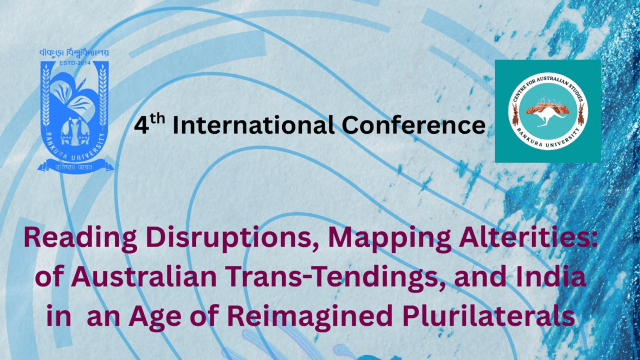
"Reading Disruptions, Mapping Alterities: of Australian Trans-Tendings, and India in an Age of Reimagined Plurilaterals"
Centre for Australian Studies, Bankura University Bankura, West Bengal, India
3-4 February 2026
The submission deadline has been extended to 05 January 2026!
In an age of black and grey swans, the swans being Nassim Nicholas Taleb’s metaphor for the apparently random or only partially predictable, outlier events with extreme impact in the domains of history, science, technology and finance, India and Australia seem resolute on an “antifragile” equation (Taleb 2012). The bilateral antifragile equation could adapt, mutate and thrive robust amidst routinised wars, weaponized tariffs, elsewhered peoples, bots mimicking intimacy and climate disasters – or so hope policy-makers, entrepreneurs and diplomats. Such an antifragile, though, would need epistemic release from the long-dominant neo-/colonial visions of India and Australia as constituting extra-metropolitan parts of one empire or the other. It compels a rupture-recourse to the ethics of reimagining alterities beyond retrotopic, ersatz versions of what Graeme Turner refers to be “the shrinking nation” (2023). India and Australia cannot emplace their relation in hermetic isolation from the rest of the planet. What if this age of chaotic bravado and deluge of mis/information be read as an alphabet of disruptions potent to design an emergent plurilateral world-order? Could India and Australia shape the chaos of events to relocate their Asian and Pacific neighbourhoods in a post-imperial, post-colonial ethic of planetarity and the fumble of translations? Could they themselves be returned to eluded possibilities of national identity and the nationing project, kindled by a ludic churn of -ness and trans-factors? How could the histories, and possibilities of maritime connections unmoor both territories from the hitherto largely inland gaze of their nationing projects, for instance? How do the two nations currently connect, and had connected, in terms of climate concerns, and environmental visions and failures? How could contemporary renewable energy commitments and AI simulations contour those connections? The conference seeks to address such and aligned questions across tense and disciplinary boundaries – of geopolitics, forgotten narratives and authors, diaspora studies, national security and strategy, history and memories, comparative studies, blue humanities, socio-cultural studies, projections in mass media, environmental studies and climate change. The term “plurilateral” renders an edge of unfinished excess, also a radioactive charge to the rhizome of entanglements between India and Australia – both spaces in un/making, made in alternatives, open to transfusions and the quantum fuzziness of radical possibilities, receptive to difference as a function of belonging, and existing in a pluripotent creatrix, in dialogue with and as part of an Asian constellation.
In its imaginative hunger for alternatives, possibilities noded and budded in the promise of entanglements, conversations, and consequent new formations, “plurilateral” exceeds the numericist binary to “mono”, pledged in “multi”. Even as the India-Australia Comprehensive Strategic Partnership marked its fifth anniversary in June 2025 with a vision for a free and plural Indo-Pacific, India is being reimagined as a hub for the joint production of naval platforms, and ship repair and maintenance in the region. New Delhi and Canberra are implementing indigenization programmes in the defence sector, making the moment ripe for collaboration in the MSME sector of defence and aerospace startups, a missed possibility thus far, observe Gaurav Saini and Kim Heriot-Darragh (The Hindu June 04 2025). Could the less-chartered Indian Ocean connect of Australia be finally highlighted in departure from the normative slant on the Asia Pacific? How could narratives in their mythic potency and rhetoricity seed the beginnings of such reimaginings? What role could the Indian diaspora play in the context? The transdisciplinary international conference seeks to engage with these and proximate research queries through the prism of geopolitics, moistened in the transformative power of imaginative revision initiated by verbal and visual texts.
“Whoever has control of history has control of the future”, contended Bill Ashcroft in his 2024 Kolkata address on “India, Australia and Democracy”. The present and the past cannot be disjoined, nor can the past be processed through the alleged transparency of hegemonic History. The non-formulaic of fumble, doubt, forgottens, indecision, disenchantment and the fecund slow of failures traced in fiction or memoirs, such as in the exilic novels of M. L. Skinner (1876-1924), could perhaps open doors to moments of past possibilities in conjuring Australia’s India, or the limn and liminals of Australianness and India studies in betrayal of empire diktats during the late nineteenth and early twentieth centuries. The conference quests to read and retrieve elusive shadow narratives and post-amnesiac pasts of Australia, India and their entanglements which could speak to the present and postal tense of the relation. It could in the process explore and cure the metastasis of myths, such as that of the “noble and skilful [Aussie] digger” (Greg Lockhart, Review of Long Tan Memory, Myths and Reality, Pearls and Irritations) tethered to the imperial triumphalism of Anglophone historiography in Australia.
The conference aims to retrieve elusive strands, missed possibilities and emergent opportunities to reimagine the role of India, Australia and Indo-Australian entanglements on the cusp of a plurilateral and planetarist world-making, when maritime geographies may yet again erupt to topple the North-South of frontiers and crises. It intends to do so through interdisciplinary interventions in geopolitics, blue and green humanities, maritime geography and history, literary traditions and aberrations, cultural studies, security and strategic studies, contested histories and the politics of memory, environmental studies, diaspora and migration. Finally, it aims to return to imagination its political-allegorical charge in remembering, contesting, restorying, border-crossing and re-mythicizing, unravel the oneiric and the fictive in the ostensibly metric, and restore to narratives and texts, the tensile pluripotency to world-make.
In context of the above, the Centre for Australian Studies, Bankura University, is pleased to invite interdisciplinary papers focussing on any of the possibilities or pasts of reimagining the role of India, Australia, their national mythologies, identities, littorals and entanglements in betrayal of a unilateral order and its neo/colonial tyranny of sameness.
Papers can be structured around, though not restricted to, any of the following sub-themes, or their convergences:
- Re-positioning India and Australia in an age of geopolitical disruptions
- Mapping the Indo-Australian bilateral through prisms of law, security, strategy, policy
- Revisiting national mythologies of Australia and/or India
- Interlinks: Reading the maritime geographies and histories of Australia and/or India
- Of histories and the politics of memory in conjuring the Indo-Pacific
- Blue humanities and the Indo-Pacific
- Postcolonial readings of Indo-Australian entanglements
- Exploring ‘failure’ as an index of alternatives in imagining the Indo-Pacific neighbourhood
- Trans-nation and the nationing project in Australia and/or India
- Environment and Ethics
- Environment and Security
- Climate Change and Migration
- Eco-literatures, environmental visions and the Indo-Pacific
- Reimagining the Economic Paradigms in Bilateral and Plurilateral Relations
- Australian and Indian Poetry and Fiction: narratives/readings dominant and elusive
- Digital transformation and Public culture
- Visual Texts and/as the Design of Disruptions
- Transcultural Exchange and Cultural Diplomacy
- Diaspora Studies and the Indian diaspora in Australia
- Of Translations: Australia’s India, India’s Australia
- Teaching Asia in Australia
- Teaching Australian Studies in India
Important Dates and Deadlines:
Abstracts of not more than 300-400 words with a short bio note of 70-100 words may be emailed to centre_australianstudies[at]bankurauniv.ac.in by 05 January 2026 (new date!).
Selected abstracts will be intimated by 10 January 2026 (new date!), and paper-presenters would be required to submit their working papers (2500 -- 3000 words) by 31 January 2026.
Find out more about the conference here.
File attachments
| Attachment | Size |
|---|---|
| CfP-CAS-BKU-4th-Int-Conf-Feb-2026-Revised-Deadline-for-Abstract-Submission.pdf | 1.15 MB |
Location
Centre for Australian Studies, Bankura University Bankura, West Bengal, India
Contact
- Centre for Australian Studies, Bankura University